How do severe thunderstorms change in a warming world?
- contact:
Jana Knandel
Prof. Dr. Michael Kunz
Dr. Susanna Mohr
Dr. Patrick Ludwig - funding:
How do severe thunderstorms change in a warming world? This is the core question of the PhD project, which is part of the working program themed "Coupled and extreme risks through weather events" of the foundation Stiftung Umwelt und Schadenvorsorge by the SV SparkassenVersicherung. A focus is on investigating the effects of climate change on the accompanying phenomena of thunderstorms, which include hail, heavy precipitation, and severe gusts.
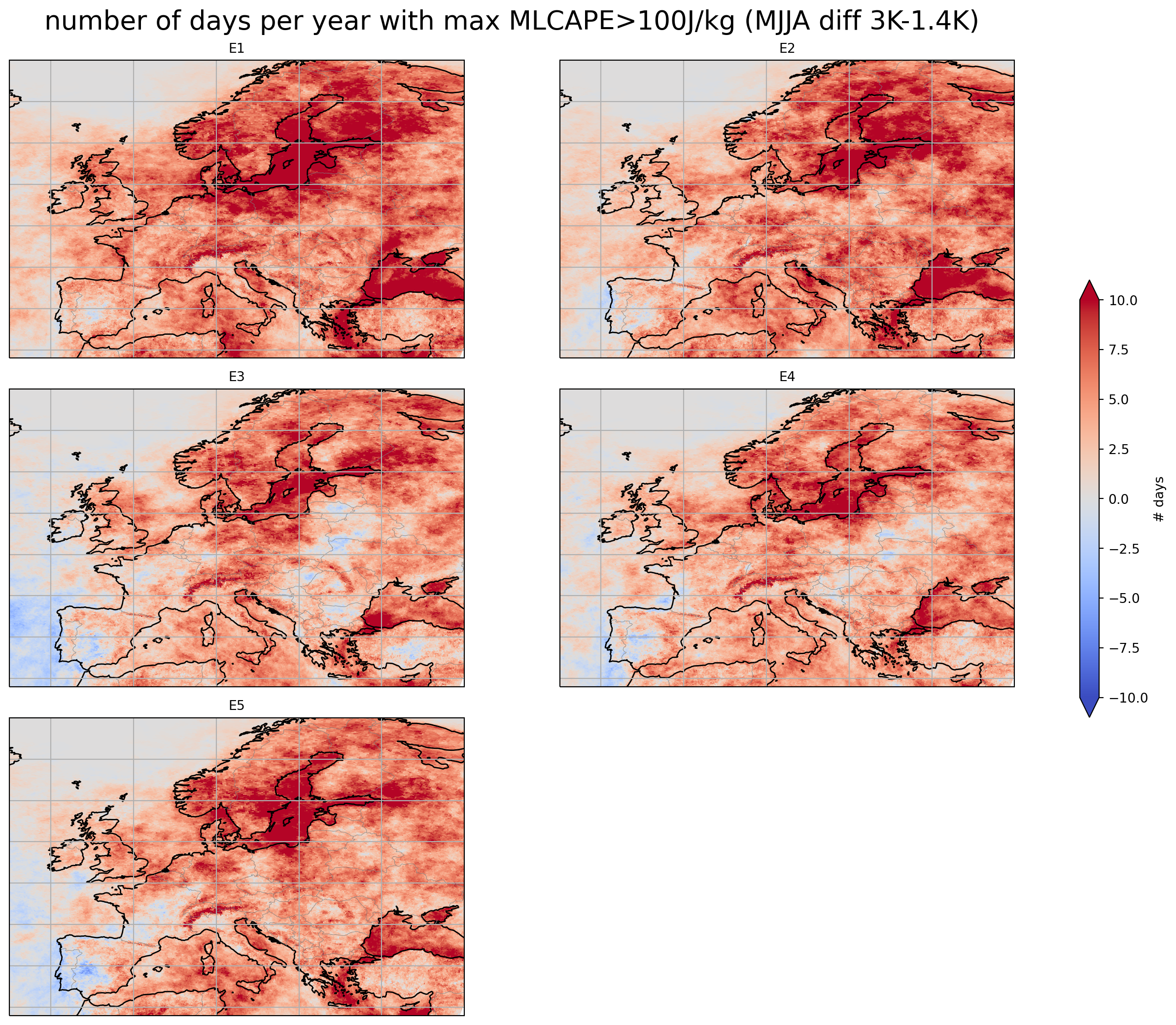
In a first step, already available, so-called "nudged" storyline simulations for the period from 2018 onwards are analyzed. In this simulation method, the large-scale atmospheric circulation of the upper troposphere from a certain historical period is embedded in a global climate model. This leads to large-scale weather patterns being reproduced realistically, while small-scale dynamic processes can evolve freely. This allows us to analyze how the weather patterns during a specific period are changing under different global warming scenarios. Therefore, conclusions can be drawn on how environmental and meteorological conditions associated with convection might change with global warming. Further, the storyline simulations allow for a more detailed examination of individual episodes with particularly intense thunderstorm activity and severe impacts.
In the second phase, a selection of severe thunderstorm events will be analyzed. Extreme thunderstorm and hail events repeatedly cause extensive damage. Often, only a few extreme events are responsible for the majority of the damage. Therefore, studying such extremes and their changes with climate change is of particular interest. To do so, in this project, the so-called Pseudo-Global Warming (PGW) approach is used. This is done by reproducing individual extreme events with simulations. The simulations are then repeated with changes in the environmental conditions (e.g., temperature, humidity, and wind profiles) that reflect the expected shifts due to climate change. This allows us to draw conclusions on how comparable events might unfold in a future climate. The goal is to use a very high resolution ($<$3\,km horizontal grid width) for the PGW simulations, such that convective processes can be explicitly resolved, and to use methods for modeling cloud physics (e.g., two-moment schemes).