

What is the value of climate resilience?
Hail is one of the costliest natural hazards in Europe. Severe convective storms like the July 2023 event in Northern Italy (De Martin et al.,2025) cause insured losses in the billions, and viticulture is particularly exposed: in many wine-growing regions, damaging hail is no longer the exception but a recurring reality. Climate change is likely to intensify such extremes further (Gensini et al., 2024).
Yet physical climate risks rarely feed into financial decisions. Investments in resilience incur costs up front, while their benefits such as avoided damage and more stable revenues, usually remain unquantified. Climate adaptation is therefore systematically undervalued. Climate reporting standards such as the recommendations of the Task Force on Climate-related Financial Disclosures (TCFD), the Corporate Sustainability Reporting Directive (CSRD, EU Directive 2022/2464), and the EU Taxonomy do require companies to disclose future physical climate risks—but there is no standardized method for quantifying these risks.
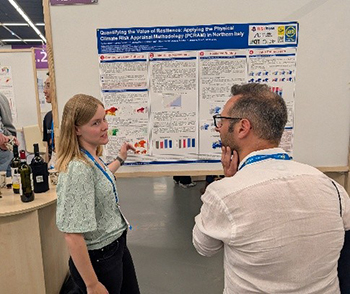
Italy study at European Geoscience Union General
Assembly in Vienna, May 2026 (©Annika Maier).
A PhD project at IMKTRO and CEDIM, launched in spring 2026, addresses this gap. It develops a scalable framework that quantifies resilience performance in financial terms supporting sustainable investment. Building on the Physical Climate Risk Appraisal Methodology (PCRAM; IIGCC, 2025), physical hazards are translated into impacts on revenues, operating and capital expenditure, and a scenario without adaptation is compared with alternative adaptation pathways over an asset's lifetime.
An initial case study (EGU26-13023; Fig. 1) tests the framework on a typical investment question in Northern Italian viticulture: is it worth installing anti-hail nets, or is subsidised hail insurance sufficient? A European hail climatology (Punge et al., 2017) is combined with vineyard, yield and insurance data, and an economic model (Rogna et al., 2019) captures the value farmers place on a stable income.
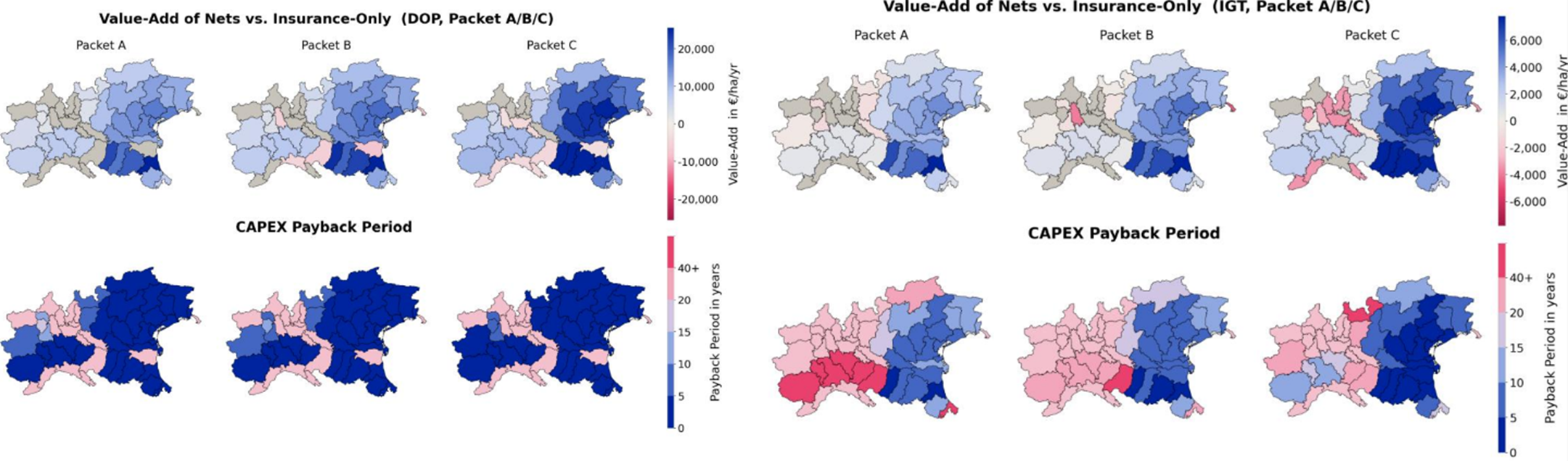
First results suggest that especially in the hail-prone northeast and for high-value appellation wines combining nets with insurance is economically superior to insurance alone in most provinces (Fig. 2). There, the investment pays for itself within a few years. Hail exposure and grape prices determine the outcome far more than installation costs, so investment subsidies have little effect. Insurance premiums that genuinely reward protected vineyards would be a more effective lever.
The Northern Italy study serves as a test bed throughout the PhD. A first focus is the hazard component: the hail climatology will be refined in spatial resolution and better constrained by additional observations, such as radar and satellite data. Further natural hazards such as flash floods will be integrated, broadening the framework towards a multi-hazard assessment that captures synergies and trade-offs between protective measures. Applying the method to the hail-prone wine region of Mendoza, Argentina, will test its transferability to a different hail climate and to different insurance and subsidy schemes. Ultimately, the framework is designed to scale from individual assets to portfolios and interconnected systems, providing investors, insurers and businesses with a robust basis for climate-resilient investment decisions.
References
De Martin, F., Manzato, A., Carlon, N., Setvák, M., and Miglietta, M. M. (2025): Dynamic and statistical analysis of giant hail environments in northeast Italy. Quarterly Journal of the Royal Meteorological Society, 151(769), https://doi.org/10.1002/qj.4945.
Gensini, V. A., Ashley, W. S., Michaelis, A. C., Haberlie, A. M., Goodin, J., and Wallace, B. C. (2024): Hailstone size dichotomy in a warming climate. npj Climate and Atmospheric Science, 7, 185, https://doi.org/10.1038/s41612-024-00728-9.
IIGCC – Institutional Investors Group on Climate Change (2025): The Physical Climate Risk Appraisal Methodology (PCRAM) 2.0.
Maier, A., Daniell, J., Kunz, M., Hinz, S., Khazai, B., Schäfer, A., Girard, T., and Brand, J.: Quantifying Resilience: Applying the Physical Climate Risk Assessment Methodology (PCRAM) to Agritourism, EGU General Assembly 2026, Vienna, Austria, 3–8 May 2026, EGU26-13023, https://doi.org/10.5194/egusphere-egu26-13023, 2026.
Punge, H. J., Bedka, K. M., Kunz, M., and Reinbold, A. (2017): Hail frequency estimation across Europe based on a combination of overshooting top detections and the ERA-INTERIM reanalysis. Atmospheric Research, 198, 34–43, https://doi.org/10.1016/j.atmosres.2017.07.025.
Rogna, M., Schamel, G., and Weissensteiner, A. (2019): Choosing between hail insurance and anti-hail nets: A simple model and a simulation among apples producers in South Tyrol. BEMPS – Bozen Economics & Management Paper Series, 62, Free University of Bozen-Bolzano.
Associated institute at KIT: Institute of Meteorology and Climate Research Troposphere Research (IMKTRO)
Author: Annika Maier (October 2026)