

Simulated hail trajectories indicate increasing hail size under climate change
As part of the Willis Hail Hazard Assessment project, we collaborated with Matthew Kumjian and Kelly Lombardo from Pennsylvania State University to investigate the influence of climate change on hail using their detailed hail trajectory model (Kumjian and Lombardo, 2020). This method (Fischer et al., 2025) offers a new perspective compared with the existing literature on hail in a changing climate (Raupach et al., 2021). To relate the results to real thunderstorms, hail trajectories were simulated in a large ensemble of 171 idealised supercells. The most important factors—temperature (melting level), available water, updraft width, and updraft strength—were varied separately within the ensemble to isolate their effects.
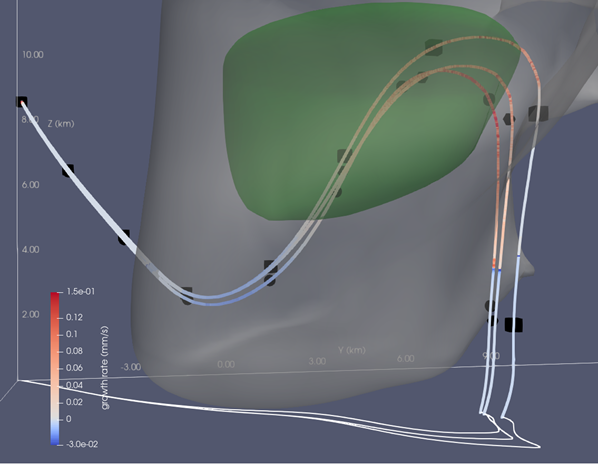
Figure 1 illustrates the trajectory of a hailstone in three simulations: a control simulation (black hexagons), a simulation with +3 K warming (black cubes), and a simulation with +2 g kg⁻¹ higher water vapor content (black spheres). The hailstone grows faster in the higher moisture simulation, while melting begins earlier in the warmer simulation. Statistical analysis of the entire ensemble reveals these processes systematically. Identical storms in a +3 K warmer environment produce less hail of all sizes. In contrast, increased humidity yields more hail, particularly at larger diameters, due to faster growth.
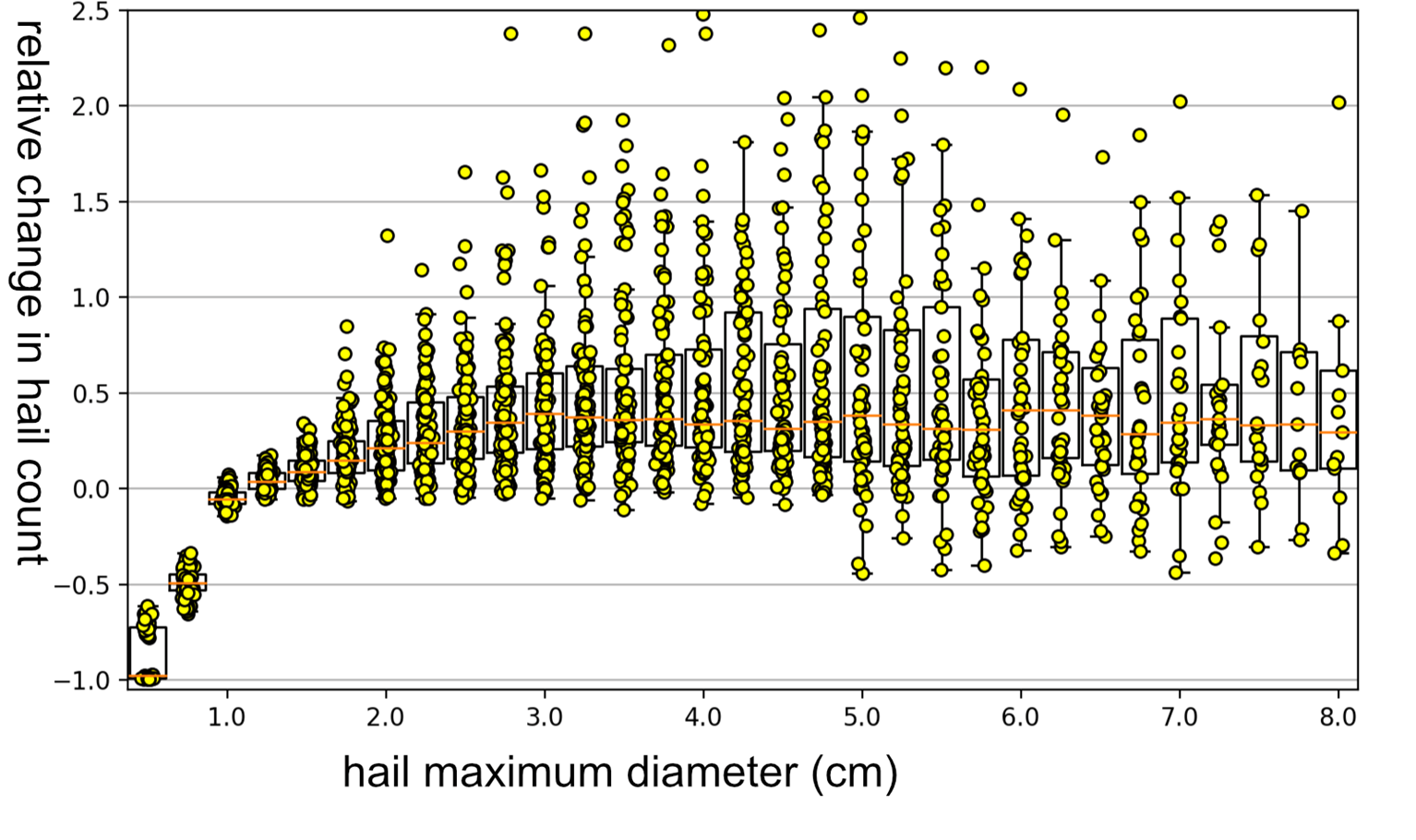
As shown in Figure 2, when temperature and humidity increase simultaneously, as is expected in most regions of the Earth under climate change (Raupach et al., 2021), the frequency of small hail decreases, while the incidence of large hail (>2 cm) rises sharply (30–40%) and the area affected by hail expands (20%). These results align with those of other studies based on models with coarser resolutions (Raupach et al., 2021; Gensini et al., 2024; Thurnherr et al., 2025) and underscore the likely increase in hail damage across Europe and many other regions. Furthermore, this study does not consider changes in the frequency of strong thunderstorms (e.g., due to drier conditions) or alterations in aerosols and their microphysics, which affect hail formation. This is why observed trends in some regions might disagree (see recent news Link1 and Link2). Further research is needed to weigh all these factors in the context of climate change.
References:
Fischer, J., Kunz, M., Lombardo, K., Kumjian, M. R. (2025): Hail Trajectories in a Wide Spectrum of Supercell-Like Updrafts. Journal of the Atmospheric Sciences, 82(7), 1403–1422, https://doi.org/10.1175/JAS-D-24-0222.1.
Gensini, V. A., Ashley, W. S., Michaelis, A. C., Haberlie, A. M., Goodin, J., Wallace, B. C. (2024): Hailstone size dichotomy in a warming climate. Npj Climate and Atmospheric Science, 7(1), 185, https://doi.org/10.1038/s41612-024-00728-9.
Kumjian, M. R., Lombardo, K. (2020): A Hail Growth Trajectory Model for Exploring the Environmental Controls on Hail Size: Model Physics and Idealized Tests. Journal of the Atmospheric Sciences, 77(8), 2765–2791, https://doi.org/10.1175/JAS-D-20-0016.1.
Raupach, T. H., Martius, O., Allen, J. T., Kunz, M., Trapp, S. L., Mohr, S., Rasmussen, K. L.,Trapp, R. J., Zhang, Q. (2021): The effects of climate change on hailstorms. Nature Reviews Earth and Environment, 2, 213–226, https://doi.org/10.1038/s43017-020-00133-9.
Thurnherr, I., Cui, R., Velasquez, P., Wernli, H., Schär, C. (2025): The effect of 3°C global warming on hail over Europe. Geophysical Research Letters, 52, e2025GL114811, https://doi.org/10.1029/2025GL114811.
Associated institute at KIT: Institute of Meteorology and Climate Research – Troposphere Research (IMKTRO)
Autor: Jannick Fischer (May 2026)