Research and assessment deficits in long-term disasters: The 2025 algal bloom in South Australia
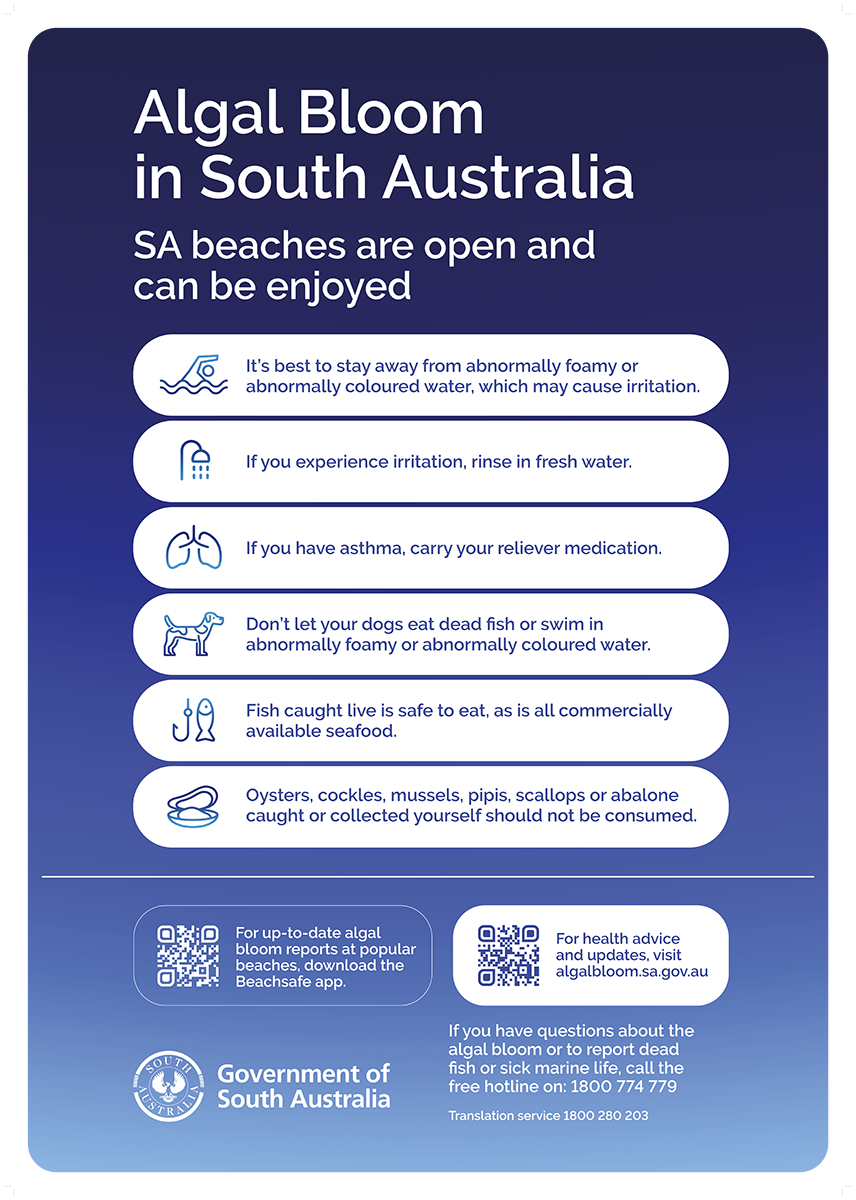
The algal bloom in South Australia is one of the largest algal bloom events recorded in Australia, now lasting close to ten months and resulting in widespread fish kills, environmental damage, tourism impacts, and human health issues, particularly along the Adelaide coastlines of the Gulf of St Vincent. Over 200 species have been found dead, with catch volumes for many species reduced by approximately 90–95%, including abalone, garfish, calamari, and crabs. A group of John Monash Scholars in Australia, working in collaboration with scientists from CEDIM, has been undertaking a rapid damage assessment of the algal bloom and has established a health reporting form to collect reports on human health impacts as well as effects on animal (Link).
There are several countries that have conducted extensive research on algal blooms due to their substantial impacts over time. China explicitly classifies severe red tides (coastal algal events) as marine disasters and applies a standardised methodology for loss investigation and assessment across aquaculture, tourism, industrial water intake and effluent, emergency operations, human health, and ecological impacts (HY/T red-tide disaster-loss guideline; Ministry of Natural Resources, draft, 2023). The applied formulae aggregate direct aquaculture losses (market-size and seed-stage), emergency and monitoring costs, and service disruptions. Annual Marine Disaster Bulletins regularly report harmful algal bloom (HAB) impacts alongside storm surge, waves, ice, and other hazards (Ministry of Natural Resources, 2024).
Florida in the USA employs sophisticated indices and indicators to quantify the severity of harmful algal blooms, monitor environmental conditions, and measure ecosystem impacts. These standardised metrics allow for consistent monitoring and comparison across time and space. The region has experienced numerous red tide events over recent decades.
Literature from Florida and China indicates that fluvial nutrient exports are strongly correlated with harmful algal bloom events. South Australia’s 2025 event (dominated by Karenia spp., **initially identified as K. mikimotoi and later also as K. brevis and K. cristata **) demonstrates the same hazard sequence observed in China and the USA: nutrient-rich flood pulses combined with a marine heatwave and a stable water column → toxic algal bloom → fish and megafauna mortality, as well as respiratory and eye irritation in animals and humans caused by aerosols and sea foam (consistent with the GEOHAB/UN HIPs framework; Glibert et al., 2018).
In Australia, there is limited provision for longer-term environmental disasters or other disaster types where the economic impacts are not immediately apparent, making it difficult to define such events as disasters for the purposes of government funding, recovery, and response. Similar challenges were observed globally during the COVID-19 pandemic, and have also been evident in heatwave and drought events, where impacts are likewise difficult to characterise. This challenge often arises because such disasters span multiple news cycles, economic cycles, and political agendas, combined with fluctuating information availability and evolving impacts over time. This further exacerbates the consequences of long-term disasters, particularly in the absence of dedicated funding mechanisms. The updated version of the HIPs identifies many additional disaster types, likewise highlighting a substantial need for further research.
With the increasing frequency of marine heatwaves globally, driven by the impacts of climate change, statistics from the Harmful Algae Event Database (HAEDAT) within IODE indicate a clear rise in coastal algal events worldwide. As a result, further work is required to systematically characterise these events. Research on this topic will continue through 2026.
Further links:
-
Website with analyses, library, data, and more: https://www.bloominalgae.com.au
-
Link to CEDIM's COVID-19 work: https://mecfs-research.org/en/costreport-long-covid-and-mecfs/
-
UNDRR: Hazard Information Profiles (HIPs) 2025 version: https://www.undrr.org/publication/documents-and-publications/hazard-information-profiles-hips-2025-version
-
Harmful Algal Information System (HAEDAT): https://haedat.iode.org/advancedSearch.php
-
Bulletin of China Marine Disaster: https://ikcest-drr.data.ac.cn/directory/drrmd-dn6fb7
-
Goverment of South Australia "Algal Bloom Update": https://www.algalbloom.sa.gov.au
Author: James Daniell (January 2026)