

Old trees as an essential component of urban climate adaptation
 The Black2GoGreen conference, Measuring Urban Resilience – Substrates, Monitoring and Ecosystem Services, was hosted by Geisenheim University and attended by approximately 120 people. The conference focused on the importance of trees for climate-resilient cities. Key topics included protecting and maintaining tree health, restoring valuable mature trees, and developing suitable tree substrates. One presentation by CEDIM, given by invited speaker Denise Böhnke, addressed the perception of heat in urban areas. It highlighted the importance of existing greenery for municipal climate adaptation using the East City Center in Karlsruhe as an example. The presentation emphasized the diverse ecosystem services provided by urban trees.
Discussions with experts in science, planning, and practice revealed that large-crowned old trees play a central role in the microclimate, quality of life, and ecological services. They are thus a vital component of urban climate adaptation, especially in times of increasing heat stress. However, their numbers continue to decline, as demonstrated by examples from Zurich and Munich.
Large-crowned old trees reduce local urban heat stress through their high shading and evaporation capacity. Their impact is immediately apparent when comparing two scenarios: a street lined with old trees that shade facades, sidewalks, parking lots, and the roadway, and the same street with newly planted trees that only shade their own tree pits (see Figure). The significant benefits provided by mature trees cannot be replaced by new plantings alone.
A central point from the presentations and discussions was that: Under current conditions, newly planted trees do not grow to the size of the mature trees we are losing. There are several reasons for this. Today, urban trees often grow under constant stress due to compacted soils, water shortages, oxygen deficiency, severely limited root zones, heat, drought, diseases, and pests. The size of the root zone significantly affects the tree's maximum crown size and achievable lifespan. Standard tree pits (12 m²) limit growth and lifespan to 20–30 years, meaning new plantings will inevitably reach only a fraction of the size of mature trees.
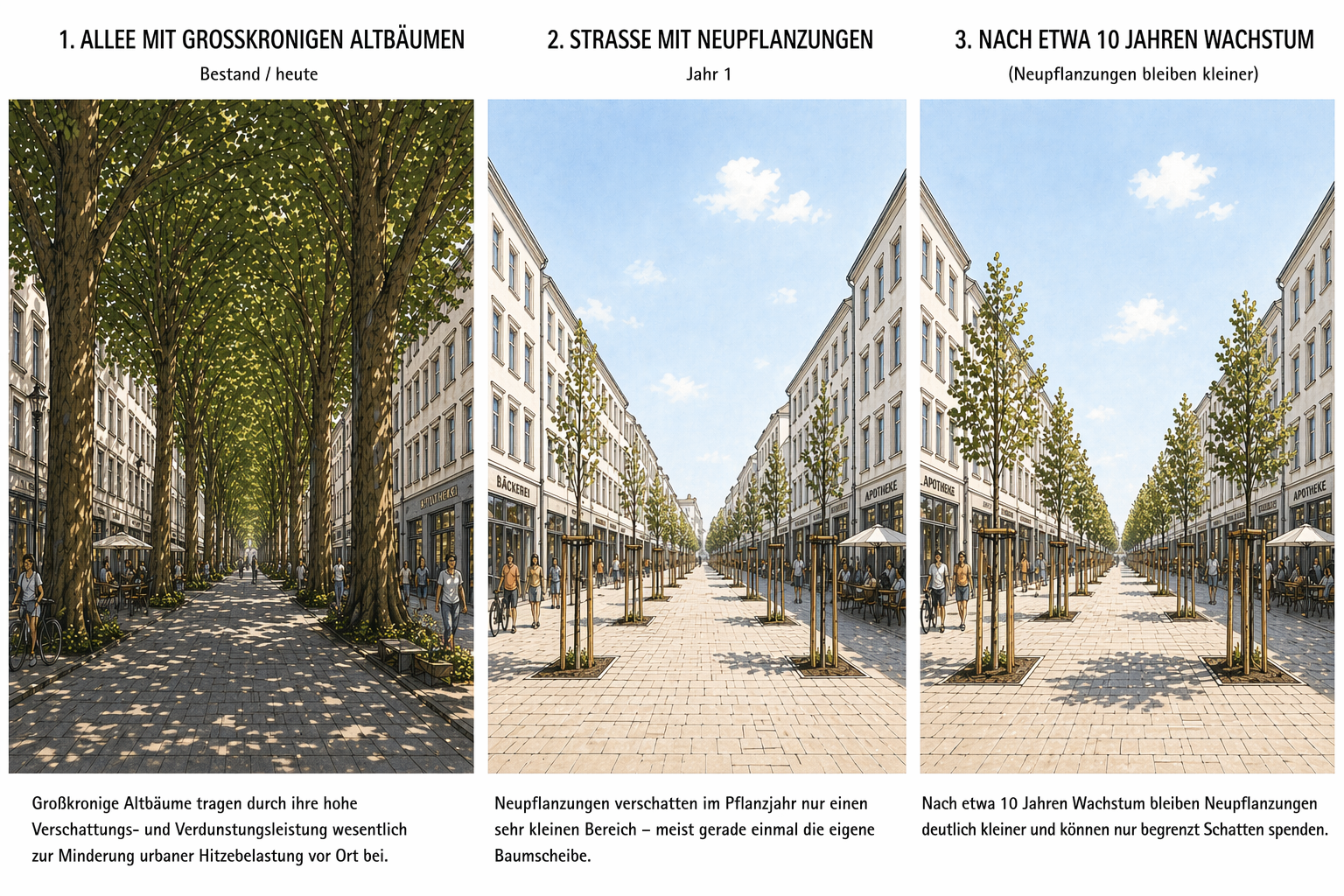
Additionally, research findings from Munich show that urban tree growth has slowed significantly over the past decade compared to earlier decades. Trunk growth has decreased significantly during dry years and the following years—a pattern that will recur more frequently due to climate change. Therefore, new plantings will likely never, or only after a long delay, achieve the functions of existing trees.
What can we do to preserve and support valuable urban trees? Preserving existing trees is necessary from climate and urban ecological perspectives and requires a thorough assessment of restoration options before felling any tree. Measures such as improving soil structure, reducing soil sealing, optimizing air and water supply, and applying specific mycorrhizal fungi promote root health and soil biology. According to Damian Jörren, a restoration specialist at TFI with 40 years of experience restoring old tree sites using pressure lances and substrate injection, restoration is often possible and significantly improves tree health, as demonstrated on individual trees and entire tree-lined avenues.
At the same time, risks must not be ignored. Old trees require regular inspections, professional care, and condition assessments, especially in areas where traffic safety, critical infrastructure, or structural compaction are concerns. A differentiated, case-by-case assessment is crucial, with preservation given priority.
The following applies to new plantings: Investing early in good site conditions prevents the need for costly replacement and maintenance measures later on. This is particularly true for available root space and suitable tree substrates that optimize the availability of nutrients, oxygen, and water. Another key takeaway from the conference was the importance of tree diversity. In cities, we should avoid planting only a few "trendy tree species" or so-called climate trees. A broad range of species is necessary to reduce the risk of failure and make urban green spaces more resilient in the long term. The design of the tree pit and its surroundings also plays an important role. A well-thought-out combination of trees, shrubs, and perennials can improve soil quality, retain water, and stabilize the site.
Another conclusion of the conference was the need for a diverse range of tree species. In cities, we should not only plant a few "trendy" or "climate-friendly" tree species. Rather, a broad range of species is required to reduce the risk of failure and make urban green spaces more resilient in the long term. Additionally, tree pits should be planted with shrubs and perennials to improve soil quality, increase water retention, and protect tree roots more effectively.
Experienced practitioners from various cities agreed that trees always grow toward water — that is, into existing water infrastructure. Technical countermeasures do not prevent this. When the roots of existing trees grow into sewers, the trees are supplied with water and nutrients, so they require less maintenance than new plantings. Therefore, the risks of sewer damage caused by trees should be examined on a case-by-case basis and reevaluated in light of the potential benefits. Thus, the standard argument used in planning practice for felling trees due to the risk of sewer damage would need to be reassessed.
Discussions at Black2GoGreen have demonstrated that urban trees are part of a sustainable urban infrastructure, not merely design elements. Preserving and caring for existing and mature trees, as well as optimizing site development for new plantings, are central components of long-term, sustainable urban green planning. These measures strengthen the climate resilience of the entire city.
The presentation PDFs are available here.
Cited presentations:
- Dr. Clemens Heidger, ö.b.v. Sachverständiger, Hannover: „Bäume in Stadtstraßen – Grundlagen und frühe Erfahrungen als Ausgangspunkt heutiger Systeme“
- Dr. Denise Heike Böhnke, CEDIM Karlsruhe Institut für Technologie (KIT): „Mapping und Bewertung von Ökosystemleistungen“
- Prof. Dr. Thomas Rötzer, Zentrum für Stadtnatur und Klimaanpassung TU München: „Wachstum, Wasserverfügbarkeit und Ökosystemleistungen von Stadtbäumen“
- Klaus Körber, Landwirtschaftsdirektor, Leiter des Sachgebietes Obstbau/Baumschule Veitshöchheim: „Klimabäume und Biodiversität im urbanen Wandel“
- Axel Heinrich, IUNR Zürcher Hochschule für Angewandte Wissenschaften: „Pflanzenverwendung für die Schwammstadt – urbane Vegetationssysteme“
- Thomas Roth, HBLFA für Gartenbau und Österreichische Bundesgärten: „Wurzelarchitektur und Kronenleistung: Sichtung von Stadtbaumarten im Schwammstadt-System“
- Jörg Jaroszewski, Leiter der Stadtgärtnerei Stadt Stein: „Be- und Entwässerung mit Baumrigolen - Projekt der Stadt Stein“
- Dr. Jürgen Kutscheidt, mycorrhiza.de: „Mykorrhizaanwendungen zur Pflanzung und zur Baumsanierung“
- Damian Jörren, Spezialist Standortsanierung mit TFI-Tree FertilizerInjection, tfi – vitaleres Grün: „Sanierung verdichteter Baumstandorte mit Drucklanzen – ein gesunder Boden für vitales Grün“
Author: Denise Böhnke (April 2026)